Hybrid WAN Edge and Site Extension
Overview
Hybrid WAN Edge and Site Extension establishes a reusable routing baseline for sites that do not control a stable public IP. A Hetzner-hosted VyOS edge pair anchors public connectivity, the on-prem site extends into that edge, and the GCP hub exchanges routes over the same control plane.
It is the network foundation behind the burst and DR lanes.
Case study
- Context: the on-prem site had no stable public IP. Every time a DR or burst path was scoped, connectivity had to be re-established from scratch because there was no fixed WAN anchor to build on.
- Challenge: without a reusable routing baseline, each upstream service (burst, cloud DR, VPN peering) was solving the same connectivity problem independently and inconsistently.
- Approach: a Hetzner-hosted VyOS edge pair provides the fixed public anchor through
org/hetzner/vyos-edge-foundation. GCP exchanges routes throughorg/gcp/wan-vpn-to-edge. The on-prem site extends into the edge throughplatform/network/vyos-site-extension-onpremrather than directly into the cloud hub, keeping the layers independent. - Outcome: the recorded exercise established one reusable WAN baseline for both DR and burst. Both GCP BGP sessions established successfully, and on-prem reachability to the recovery subnet was confirmed without rebuilding the route path for each service.
Shows the fixed public edge pair, GCP hub peering, the on-prem site-extension layer, and confirmed reachability from the on-prem runner to the GCP recovery subnet.
Outcome
The result is a reusable routing foundation that does not depend on a stable on-prem public IP.
- A fixed public edge pair anchors the WAN posture.
- Site extension and cloud hub routing remain separate but connected control layers.
- Cloud recovery and burst paths reuse the same network baseline instead of rebuilding connectivity for each service.
Operating model
- Hetzner-hosted VyOS nodes provide the fixed public edge.
- The on-prem site extends outbound to that edge instead of pushing local address instability directly into the cloud hub.
- GCP exchanges routes through redundant HA VPN and BGP peers.
- Observability and control remain separate from the routed data path.
Architecture
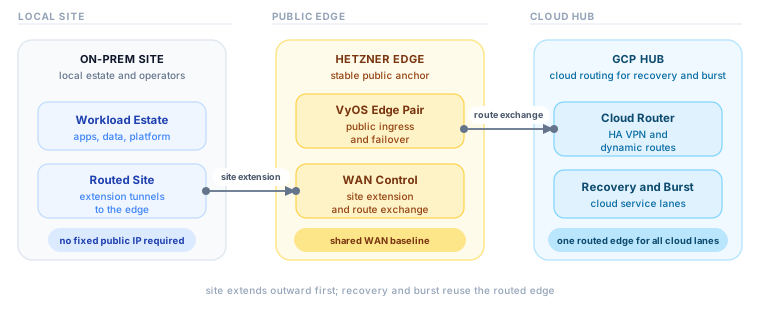
The site extension and HA VPN links are peer relationships, so the diagram uses endpoint ports rather than directional arrows. The on-prem site reaches a stable Hetzner edge anchor; that edge terminates the GCP VPN path, and Cloud Router propagates learned routes to recovery and burst subnets.
Routing sequence
- The Hetzner edge pair establishes the fixed public WAN anchor.
- The GCP hub exchanges routes with that edge through HA VPN and BGP.
- The on-prem site extends into the same edge through its own routed layer.
- On-prem workloads can then reach cloud recovery or burst subnets through the shared WAN baseline.
Platform state
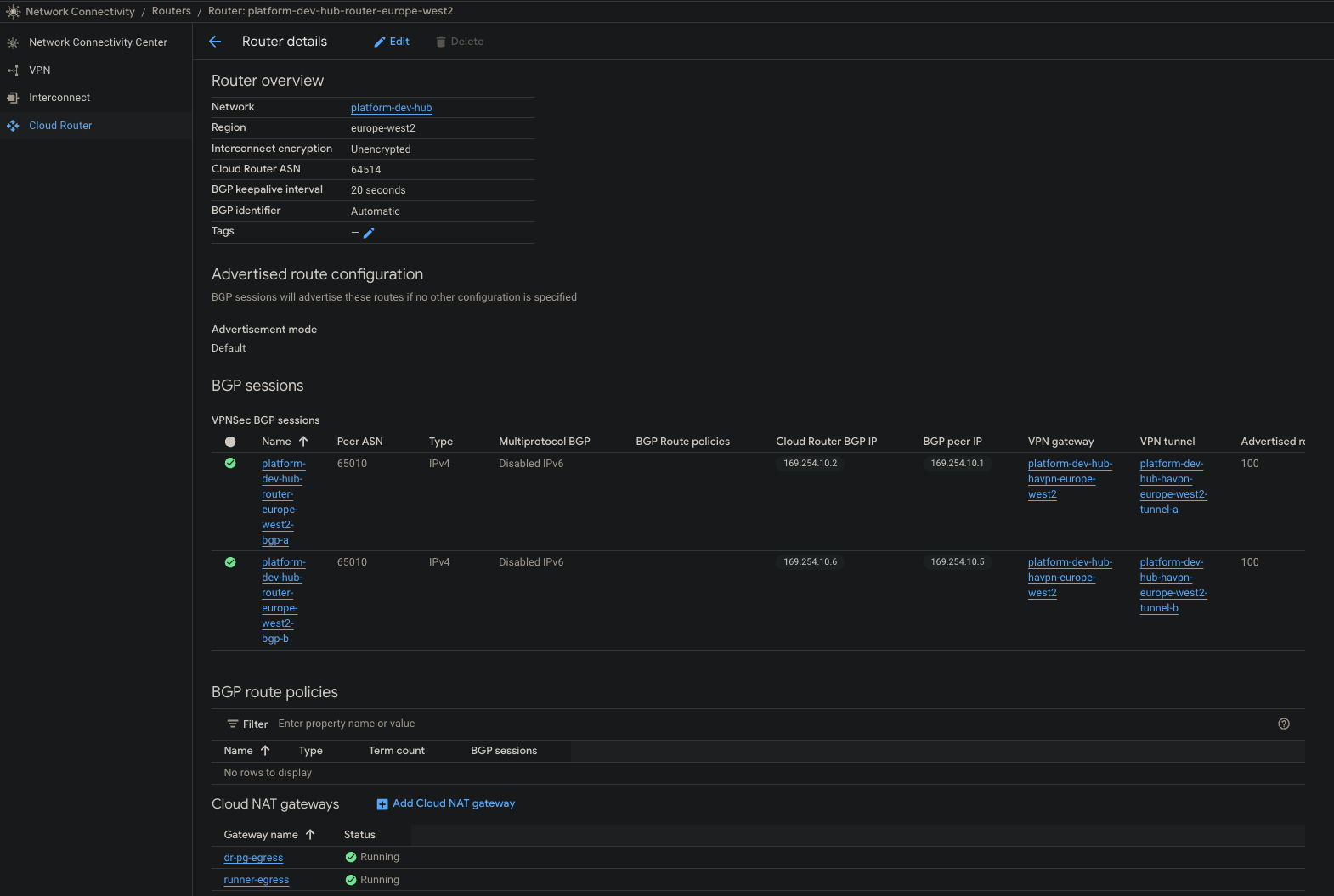
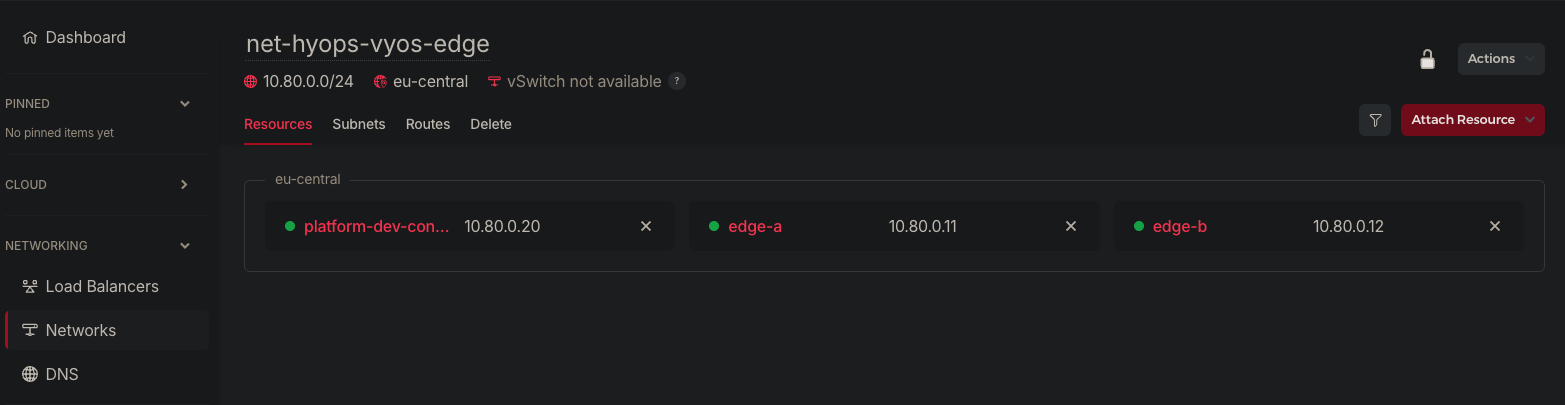
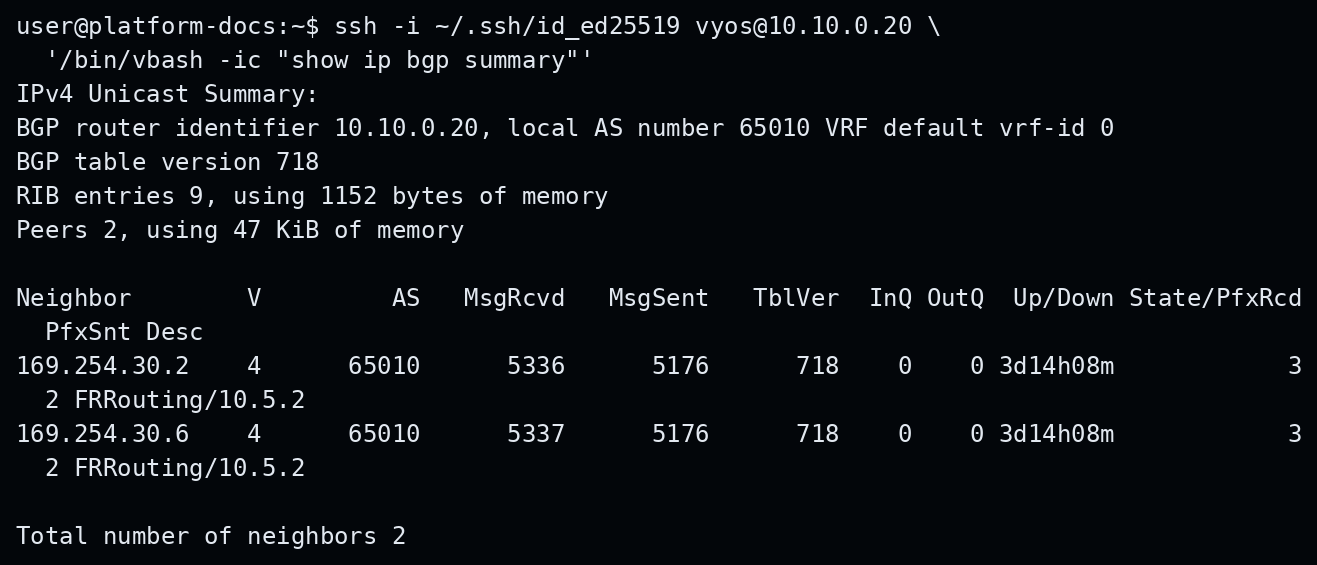
IP addresses, hostnames, and instance identifiers visible in screenshots and recordings reflect the ephemeral infrastructure provisioned during the recorded exercise.
Implementation
- Public edge anchor: the Hetzner VyOS pair provides a stable public WAN anchor.
- Cloud hub routing: GCP HA VPN and BGP handle route exchange with the cloud side.
- On-prem extension: site extension keeps the local edge independent from the cloud hub.
- Observability: Grafana and Thanos provide the operator view of edge and control state.
Key components
- Edge foundation:
org/hetzner/vyos-edge-foundation - GCP hub peering:
org/gcp/wan-vpn-to-edge - Edge WAN control:
platform/network/vyos-edge-wan - On-prem site extension:
platform/network/vyos-site-extension-onprem - Observability:
platform/network/edge-observability
Where it fits
- hybrid estates without a stable on-prem public IP
- branch, campus, or customer sites that need reusable cloud connectivity
- DR and burst designs that require a reusable routing control plane first
References
Further reading
Implementation references
org/hetzner/vyos-edge-foundationorg/gcp/wan-vpn-to-edgeplatform/network/vyos-edge-wanplatform/network/vyos-site-extension-onpremplatform/network/edge-observability
Related
Related reading
- Network Architecture
- Deploy Edge Control Plane (HyOps Blueprint)
- Extend On-Prem Into Hetzner Site-A (HyOps Blueprint)
- Burst Web Platform on GKE
- PostgreSQL HA DR Cycle
What was verified
Verified during the recorded HybridOps v1.0.1 WAN exercise with the fixed public edge pair, GCP hub peering, on-prem site extension, and reachability to the GCP recovery subnet confirmed.