Network Lab Continuity Across Ephemeral Compute
Overview
High-resource network labs can preserve continuity while their execution compute remains ephemeral. HybridOps applies one surrounding lifecycle to EVE-NG, GNS3 and Containerlab: prepare the execution target, verify the lab, provide private operator access, preserve the continuity state required for the next session, release compute when that gate passes, and reconstruct the environment later.
Each lab platform remains authoritative for its topology, nodes and native recovery semantics. HybridOps governs the execution-host lifecycle, private access, preservation policy, release gate and evidence around those systems.
| Lab platform | Execution targets | Continuity contract |
|---|---|---|
| EVE-NG | Google Cloud and Proxmox | Lab definitions plus selected stopped-QEMU overlay state |
| GNS3 | Google Cloud and Proxmox | Project and controller state including writable node disks |
| Containerlab | Google Cloud | Topology plus native save, redeploy and snapshot-recovery semantics supported by the selected nodes |
The operating boundary is the same across the three paths: useful lab state is protected before ephemeral execution capacity is released.
Case study
- Context: network and security labs can outgrow workstation CPU, memory and nested-virtualisation capacity, while keeping equivalent cloud compute running between sessions ties continuity to an idle host.
- Challenge: topology source alone may not be enough. Depending on the lab, continuity can also require writable node disks, controller state, native save products, image availability, private management access and final health proof.
- Approach: HybridOps resolves the target and continuity policy, prepares the execution host, hands topology and node behaviour to the selected lab platform, verifies the retained recovery set away from the host, and uses that proof as the release gate.
- Outcome: the same operating contract now covers EVE-NG and GNS3 on Google Cloud and Proxmox, plus the validated Google Cloud Containerlab lifecycle in which the original host was removed and the lab reconstructed on fresh compute.
Shared lifecycle
| Stage | Operating result |
|---|---|
| Prepare | Target credentials, capacity, virtualisation support, runtime directories and required inputs are checked before deployment. |
| Deliver | The selected platform is installed or prepared and receives its declared topology, images and environment-specific configuration. |
| Verify | Platform health is checked independently of infrastructure creation. |
| Access | Private UI, console or device-management paths are created for the active session where the platform requires them. |
| Preserve | The recovery set required by the selected continuity policy is produced and verified away from the execution host. |
| Release | Compute is retained or released according to the declared continuity decision and terminal infrastructure state is recorded. |
| Reconstruct | Fresh compute is prepared, retained state is re-verified, the owning lab platform performs its native deployment or restore, and final lab health is checked. |
Architecture
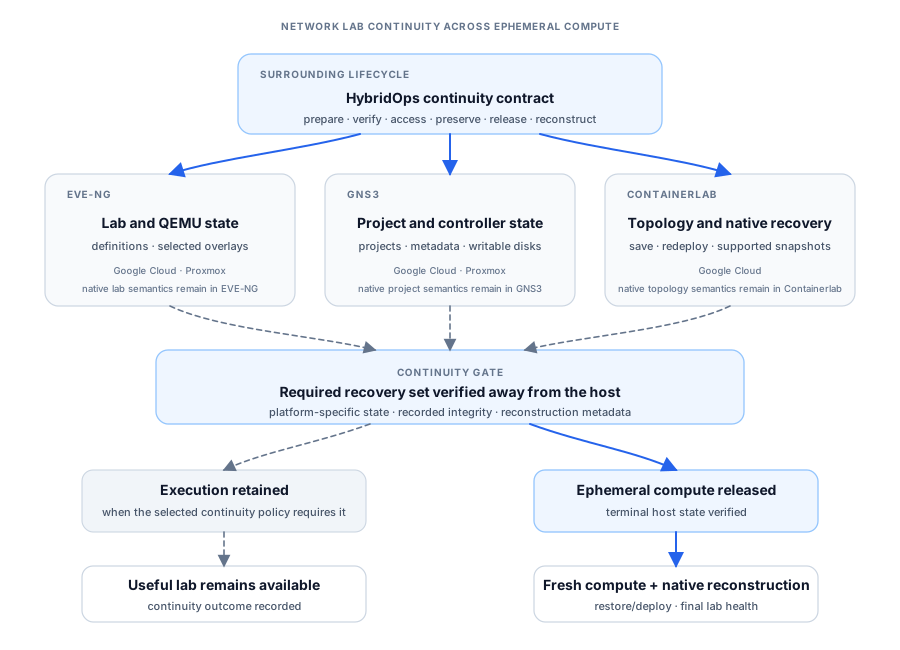
The lifecycle stays common while the retained recovery set remains platform-specific. EVE-NG owns its labs and QEMU state, GNS3 owns project and controller state, and Containerlab owns topology deployment and native recovery behaviour. The shared release rule is that the selected continuity outcome is protected before the execution host becomes disposable.
Continuity contracts
EVE-NG
The EVE-NG path retains lab definitions and, when required, selected stopped-QEMU overlays that contain node-owned changes. Base images, licence material and environment secrets remain independently managed and are reapplied when fresh capacity is prepared.
GNS3
The GNS3 path retains project directories and controller metadata. Project state includes topology files and writable node disks. Restore verifies the recorded integrity value before the retained state is applied to the reconstructed service.
Containerlab
Containerlab remains authoritative for .clab.yml, nodes, links, convergence,
native save behaviour and supported snapshot or restore semantics. The validated
Google Cloud path verified the recovery set off-host, removed the original VM,
created replacement compute with a different resource identity, reconstructed the
lab through native Containerlab deployment, passed final health and removed the
declared compute at closure.
Private operator and device access
EVE-NG and GNS3 can expose session-scoped private access from the operator workstation without publishing topology-node management interfaces directly to the public network. The current paths support platform access, console use and managed topology-node access for local automation tools. Live endpoint discovery and generated client material are session state; durable device metadata remains with its declared authority.
Worked EVE-NG path
The recording and screenshots below show the original cross-target EVE-NG path on Google Cloud and Proxmox. That path is one worked implementation of the wider network-lab continuity contract.
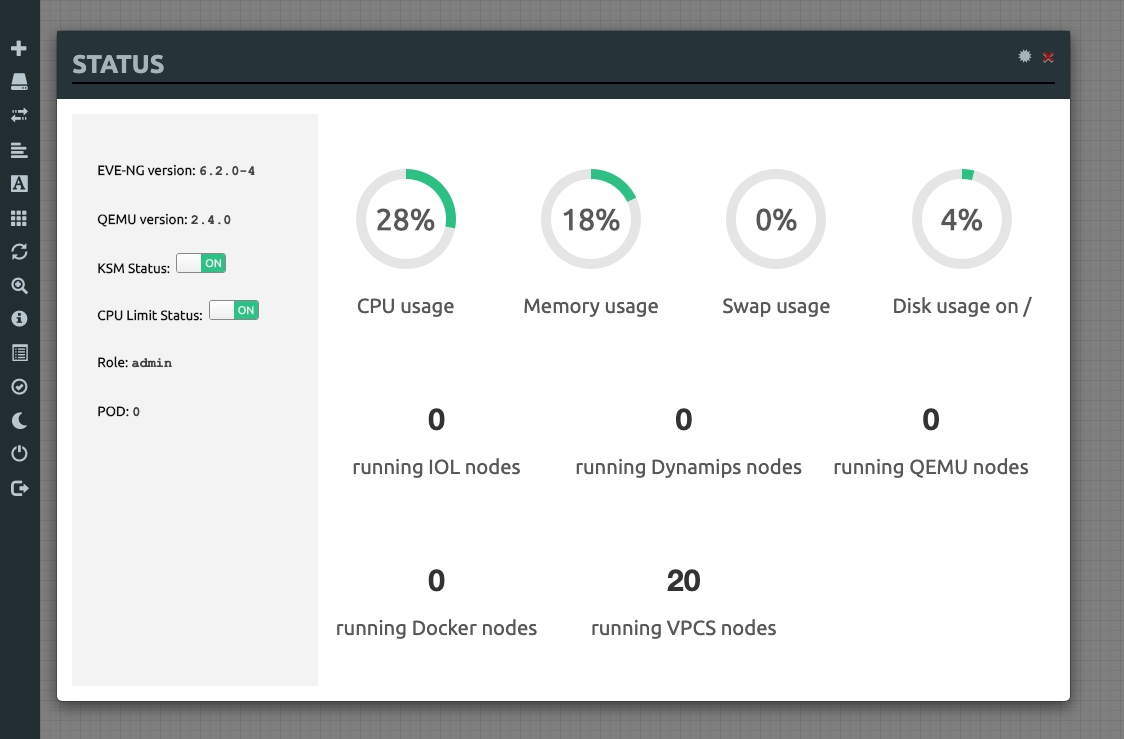
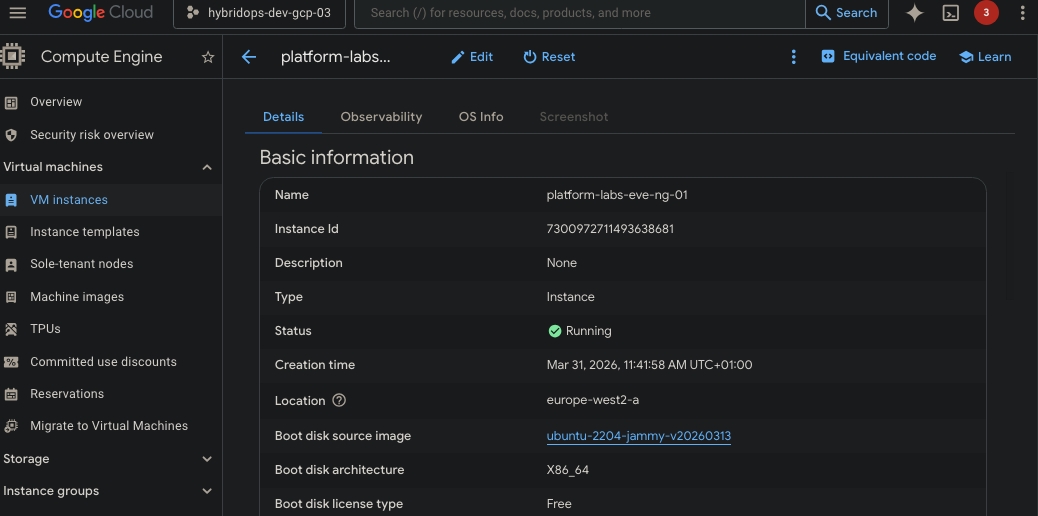
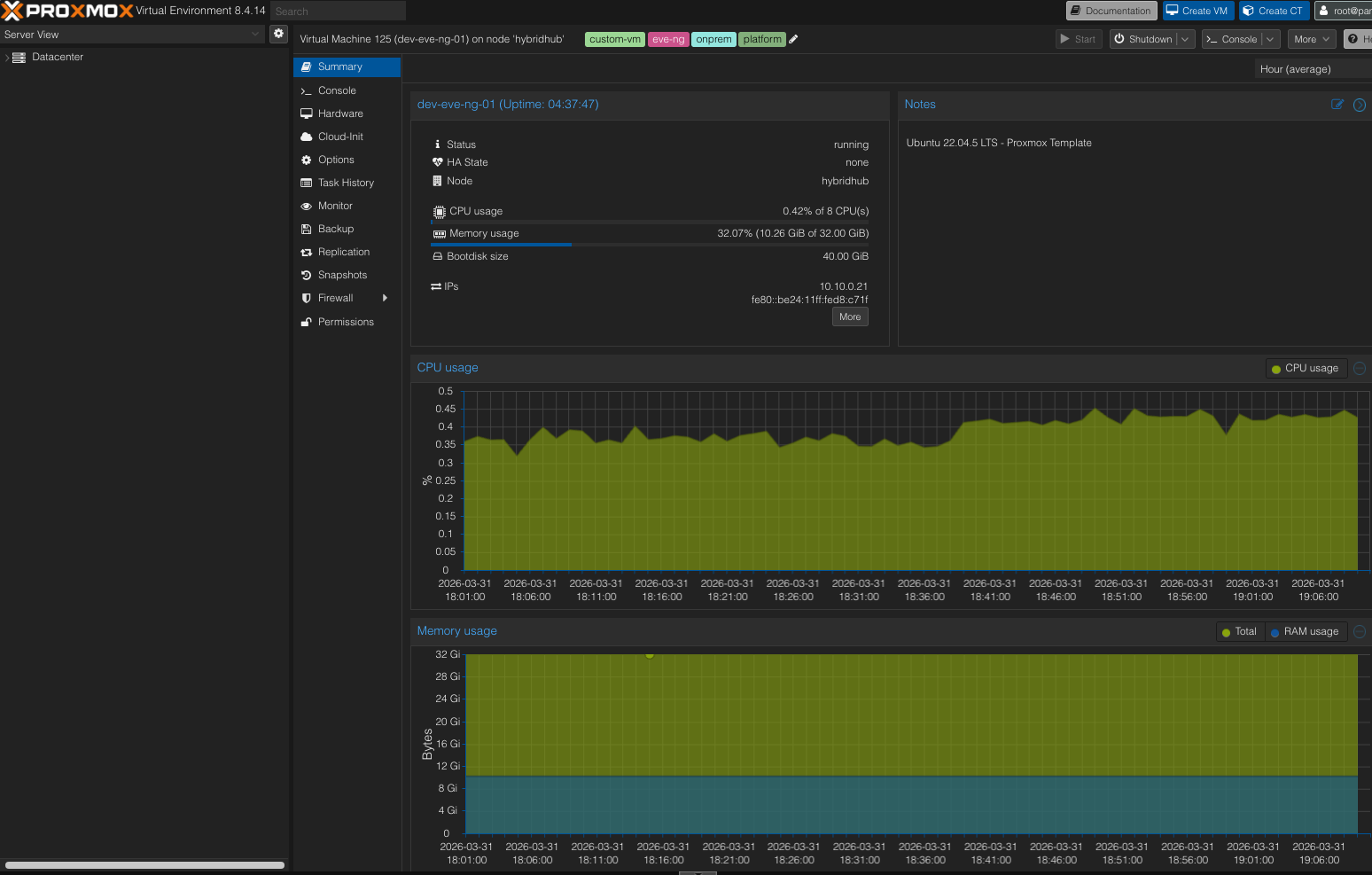
IP addresses, hostnames and instance identifiers visible in the screenshots and recording belong to the ephemeral environments used for the exercise.
Implementation
| Platform | Google Cloud | Proxmox | Operator path |
|---|---|---|---|
| EVE-NG | gcp/eve-ng@v1 |
onprem/eve-ng@v1 |
Operate EVE-NG |
| GNS3 | gcp/gns3@v1 |
onprem/gns3@v1 |
Operate GNS3 |
| Containerlab | gcp/containerlab@v1 |
n/a | Operate Containerlab |
Where it fits
- network and security labs that exceed workstation capacity
- training environments that need continuity with high-resource execution allocated for active sessions
- practitioner labs that need private management access from local automation tools
- repeated cloud lab sessions where preservation, teardown and reconstruction must be explicit
- cross-platform evaluation where emulator-native semantics remain authoritative
References
Further reading
Related
Related reading
- EVE-NG Network Simulation Architecture
- Operate EVE-NG
- Operate GNS3
- Operate GCP Containerlab
- Network Architecture
Validation scope
EVE-NG and GNS3 have exercised Google Cloud and Proxmox delivery paths with their
current continuity contracts. The Google Cloud Containerlab path completed
end-to-end release and fresh-host reconstruction validation before merge to Core
main. The EVE-NG screenshots and recording above remain the worked visual record
for the original cross-target lab path.