Secret Delivery Pipeline
Overview
Secret Delivery Pipeline follows the path from GCP Secret Manager to a live Kubernetes secret while keeping secret-value authority separate from the authentication mechanism used to read it. GCP Secret Manager owns the values, ESO performs the reconciliation, and applications consume materialised Kubernetes Secrets.
On-prem RKE2 authenticates ESO through a one-time bootstrap credential. GKE uses Workload Identity. Both surfaces converge on the same ClusterSecretStore and ExternalSecret delivery contract.
Case study
- Context: application secrets were spread across environment files and manual operator steps. There was no traceable path from GCP Secret Manager to the application namespace, and credentials were embedded in GitOps state in some services.
- Challenge: on-prem clusters needed a controlled path to cloud-held secrets while keeping the bootstrap credential out of Terraform state and Git history. GKE needed the same delivery contract without carrying that static credential model into the cloud cluster.
- Approach:
org/gcp/gsm-eso-saprovisions the reader identity.hyops init gcp --with-eso-sagenerates the on-prem bootstrap key once and writes it to the local encrypted bootstrap vault.platform/k8s/gsm-bootstraphands that credential into the on-prem cluster. GKE uses Workload Identity. In both environments,platform/k8s/gcp-secret-storeconfigures ESO and applications declareExternalSecretresources against the same store contract. - Outcome: the recorded exercise confirmed the full GCP Secret Manager → ESO → Kubernetes Secret delivery cycle on the on-prem RKE2 and GKE environments. The GKE path completed delivery and cleanup, while the on-prem bootstrap credential remained outside Terraform state and Git history.
Covers reader identity creation, on-prem key generation through hyops init, bootstrap handoff, ClusterSecretStore configuration, ExternalSecret reconciliation, and the verified secret landing in the application namespace.
Outcome
The result is one secret-delivery contract across on-prem and GKE with environment-specific authentication.
- GCP Secret Manager holds the authoritative application secret values.
- The ESO reader identity defines the permitted read scope.
- On-prem RKE2 uses a one-time bootstrap credential handed through the encrypted bootstrap vault.
- GKE uses Workload Identity for ESO authentication.
ExternalSecretreconciliation materialises the Kubernetes Secret consumed by the application.
Operating model
org/gcp/gsm-eso-sacreates the GCP reader identity with Secret Manager read access. No service-account key is created by Terraform.- For on-prem RKE2,
hyops init gcp --with-eso-sacreates the key once and writes it to the operator's local encrypted bootstrap vault asHYOPS_GSM_SA_KEY_JSON. platform/k8s/gsm-bootstrapreads the bootstrap value and creates the cluster-side credential used by the on-prem store.- On GKE, ESO authenticates through Workload Identity instead of a static key.
platform/k8s/gcp-secret-storecreates theClusterSecretStorefor the selected environment.- Applications declare an
ExternalSecret; the ESO controller reconciles it against GCP Secret Manager and materialises a Kubernetes Secret in the application namespace.
Architecture
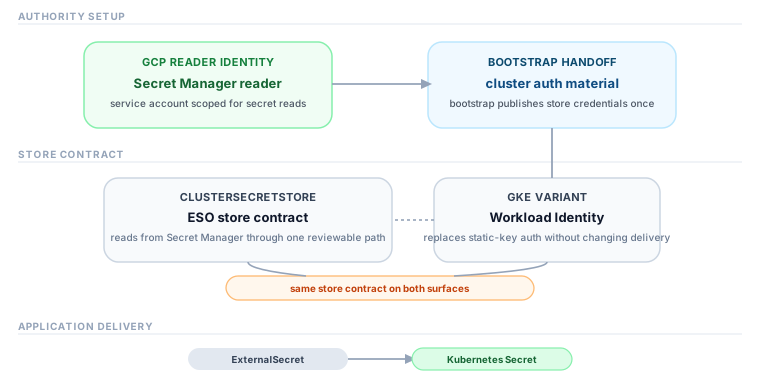
GCP Secret Manager remains authoritative for secret values. Authentication to that authority differs by environment: on-prem RKE2 uses a one-time bootstrap credential handed through the encrypted bootstrap vault, while GKE uses Workload Identity. Both surfaces configure the same ClusterSecretStore contract, which the ESO controller uses to reconcile ExternalSecret declarations into Kubernetes Secrets.
Platform state
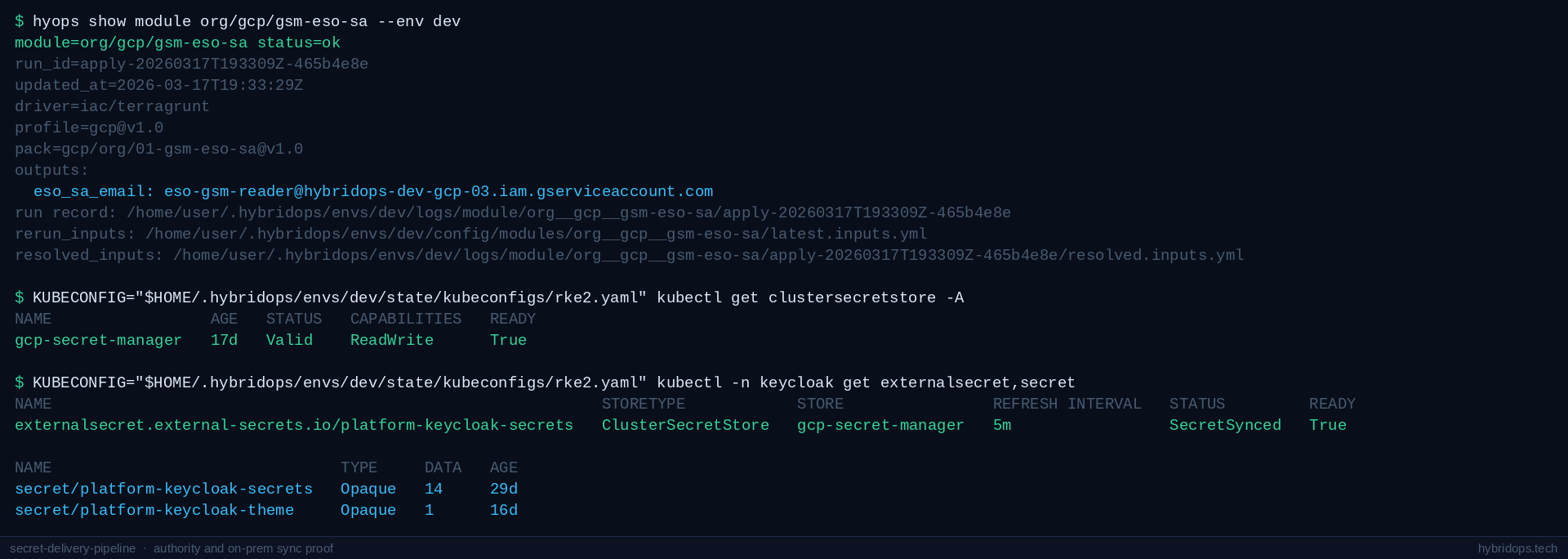
IP addresses, hostnames, and instance identifiers visible in screenshots and recordings reflect the ephemeral infrastructure provisioned during the recorded exercise.
Each stage is backed by a recorded run record. The captured exercise included a full GCP Secret Manager → ExternalSecret → Kubernetes Secret round trip on both delivery surfaces.
| Stage | Module | Run ID | Status |
|---|---|---|---|
| SA provisioning | org/gcp/gsm-eso-sa |
apply-20260317T193309Z-465b4e8e |
ok |
| Bootstrap | platform/k8s/gsm-bootstrap |
apply-20260313T230910Z-739e848c |
ok |
| GKE secret store | platform/k8s/gcp-secret-store#gke_burst_secret_store |
apply-20260318T120046Z-bc73643d |
ok |
The recorded GKE exercise completed a full GCP Secret Manager → ExternalSecret → Kubernetes Secret round trip and cleaned up the validation objects afterwards. Representative execution records are retained as part of the platform log.
Implementation
| Surface | Authentication | Delivery contract |
|---|---|---|
| On-prem RKE2 | Bootstrap SA key handed through the encrypted vault | ClusterSecretStore → ExternalSecret → Kubernetes Secret |
| GKE burst | Workload Identity | ClusterSecretStore → ExternalSecret → Kubernetes Secret |
Key components
- Reader identity provisioning:
org/gcp/gsm-eso-sa - On-prem key generation:
hyops init gcp --with-eso-sa - On-prem bootstrap:
platform/k8s/gsm-bootstrap - Secret-store contract:
platform/k8s/gcp-secret-store - GKE variant:
platform/k8s/gcp-secret-store#gke_burst_secret_store - ESO: deployed via the workload GitOps root alongside the cluster
Where it fits
- application secrets with a single authoritative source in GCP Secret Manager
- on-prem clusters that need a controlled path to cloud-held secrets
- GKE clusters using Workload Identity with the same ESO delivery contract
- platform services sharing a
ClusterSecretStoreacross application namespaces - teams moving secrets out of environment files and into a reviewable delivery path
References
Implementation references
org/gcp/gsm-eso-saplatform/k8s/gsm-bootstrapplatform/k8s/gcp-secret-storeplatform/k8s/gcp-secret-store#gke_burst_secret_store
Related
Related reading
What was verified
Verified during the recorded HybridOps v1.0.1 secret-delivery exercise. Reader identity provisioning was confirmed, the on-prem bootstrap path was validated, and ClusterSecretStore delivery was exercised on both the on-prem RKE2 and GKE surfaces.